Random Variables
import numpy as np
import matplotlib.pyplot as plt
import seaborn as sns

# Set style
sns.set_theme(style="whitegrid")

def plot_discrete_rv(values, pmf, cdf, samples, rv_name):
    # Prepare Empirical CDF (ECDF)
    n_samples = len(samples)
    sorted_samples = np.sort(samples)
    ecdf_x = np.unique(sorted_samples)
    ecdf_y = [np.sum(sorted_samples <= x) / n_samples for x in ecdf_x]
    plt.figure(figsize=(15, 8))

    # Theoretical PMF
    plt.subplot(2, 2, 1)
    plt.stem(values, pmf, basefmt=" ", linefmt='-.')
    plt.title(f"Theoretical PMF: {rv_name}")
    plt.xlabel("x")
    plt.ylabel("f(X=x) = P(X = x)")
    plt.ylim(0, 1.1)

    # Theoretical CDF
    plt.subplot(2, 2, 2)
    plt.step(values, cdf, where='post', color='green')
    plt.title(f"Theoretical CDF: {rv_name}")
    plt.xlabel("x")
    plt.ylabel("F(x) = P(X ≤ x)")
    plt.ylim(0, 1.1)
    plt.grid(True)

    # Sampling Histogram
    plt.subplot(2, 2, 3)
    sns.countplot(x=samples, hue=samples, legend=False, palette='pastel', stat='proportion', order=values)
    plt.title(f"Empirical Distribution ({n_samples} samples)")
    plt.xlabel("x")
    plt.ylabel("Relative Frequency")

    # Empirical CDF (ECDF)
    plt.subplot(2, 2, 4)
    plt.step(ecdf_x, ecdf_y, where='post', color='orange')
    plt.title("Empirical CDF")
    plt.xlabel("x")
    plt.ylabel("ECDF")
    plt.ylim(0, 1.1)
    plt.grid(True)
    plt.tight_layout()
    plt.show()
Uniform Distribution (Uniform RV)
Discrete Uniform Random Variable
If a random variable $X$ takes values in a finite set of discrete numbers, and each value has the same probability of occurring, then it is a discrete uniform random variable.
Examples:
- Rolling a die: $X \in \{1, 2, 3, 4, 5, 6\}$, each outcome has probability $\frac{1}{6}$
- Randomly selecting a card (from 1 to 52)
Mathematical Definition
Let $X \sim \text{DiscreteUniform}(a, b)$, where $a$, $b \in \mathbb{Z}$, and $a \leq b$.
Support (Range):
$$ k \in \{a, a+1, a+2, \dots, b\} $$Probability of each value:
$$ P(X = k) = \frac{1}{b - a + 1}, \quad \text{for } k \in \{a, \dots, b\} $$Probability Mass Function (PMF):
$$ f(X=k) = P(X=k) = \left\{ \begin{aligned} \frac{1}{b-a+1}, \text{for } a \le k \le b\\ 0, \text{ otherwise} \end{aligned} \right. $$Cumulative Distribution Function (CDF):
$$ F(X=k) = P(X\le k) = \left\{ \begin{aligned} 0, \text{for } k \lt a \\ \frac{k-a+1}{b-a+1}, \text{for } a \le k \le b\\ 1, \text{ for } k \gt b \end{aligned} \right. $$Expectation ($\mu$): $\frac{a+b}{2}$
Variance ($\sigma^2$): $\frac{(b-a+1)^2-1}{12}$
import numpy as np

# Set random seed
np.random.seed(42)

# 1. Define Parameters
a, b = 1, 6  # Range
values = np.arange(a, b+1)  # Discrete values: 1~6
n = len(values)
pmf = np.ones(n) / n  # Equal probability
cdf = np.cumsum(pmf)  # CDF

# 2. Sampling
n_samples = 1000
samples = np.random.choice(values, size=n_samples, p=pmf)

# 3. Visualization
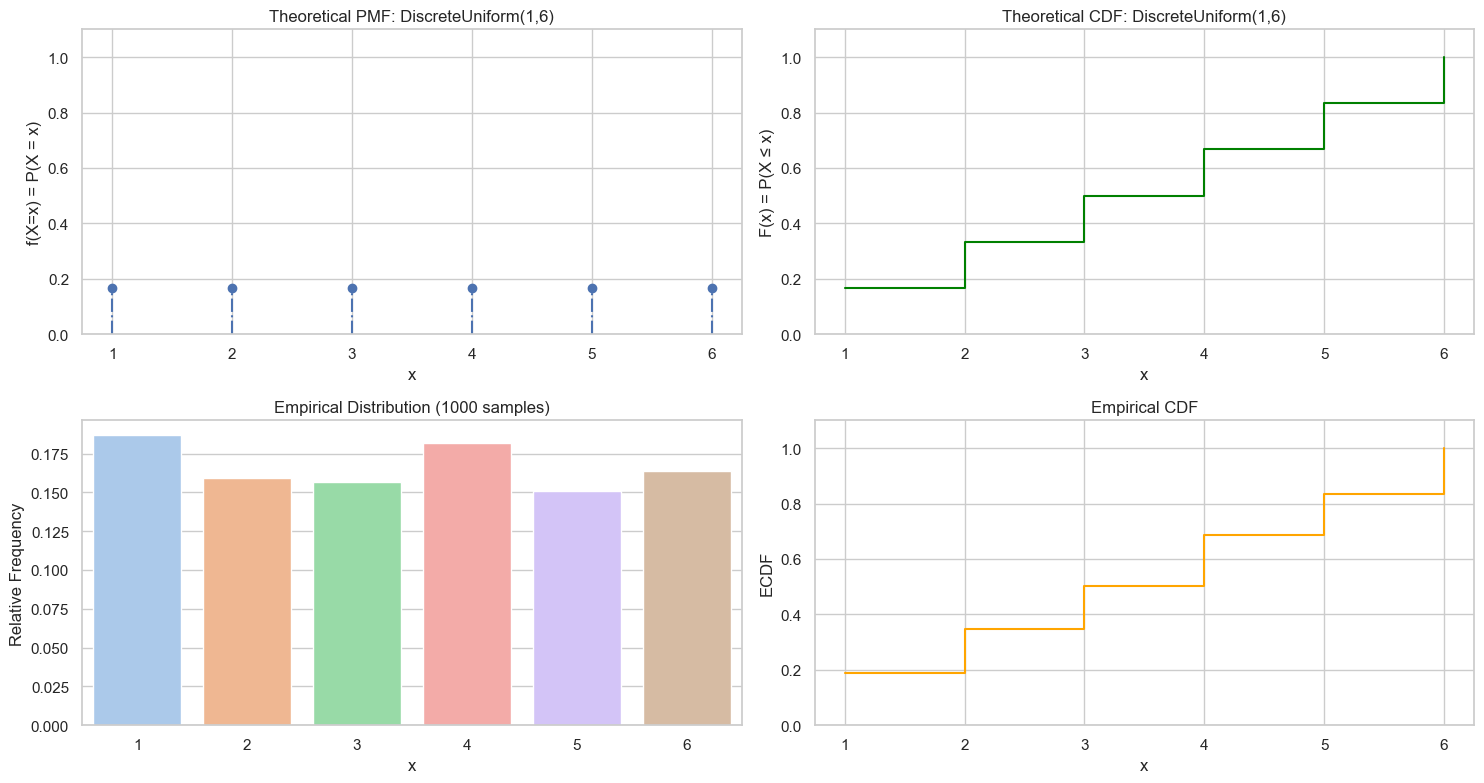
plot_discrete_rv(values, pmf, cdf, samples, f"DiscreteUniform({a},{b})")
Sampling
We use a Continuous Uniform Distribution $U \sim \text{Uniform}(0, 1)$ to generate discrete uniform random numbers.
Steps:
- Let the interval be integers from $a$ to $b$ (inclusive), total $N = b - a + 1$ numbers.
- Generate a random number $U \sim \text{Uniform}(0, 1)$.
- Map $U$ to the integer range: $$ X = a + \left\lfloor U \cdot N \right\rfloor $$ ✅ The resulting integer is one of $\{a, a+1, ..., b\}$, with equal probability.
If $a=0, b=1$, then:
- $N = b - a + 1 = 1 - 0 + 1 = 2$
- $U \sim \text{Uniform}(0, 1)$
- $X = a + \left\lfloor U \cdot N \right\rfloor = 0 + \left\lfloor U \cdot 2 \right\rfloor = \left\lfloor U \cdot 2 \right\rfloor$
Summary:
| Step | Description |
|---|---|
| Goal | Sample from $\{a, a+1, ..., b\}$ with equal probability |
| Method | Generate $U \sim \text{Uniform}(0,1)$, then $X = a + \lfloor U \cdot (b - a + 1) \rfloor$ |
| Function | random.random() or random.randint(a, b) |
| Application | Dice simulation, roulette, lottery, uniform integer sampling, etc. |
import random

def discrete_uniform_sample(a, b, n):
    N = b - a + 1
    # U ~ Uniform(0, 1)
    U = [random.random() for _ in range(n)] # random.random() returns float in [0.0, 1.0)
    # X ~ Discrete Uniform(a, b)
    X = [a+int(u*N) for u in U]
    return U, X

discrete_uniform_sample(0, 1, 10)
([0.4444854289944321, 0.951251619861675, ...],
 [0, 1, 1, 1, 0, 1, 1, 1, 0, 1])
Simpler Way (Built-in)
Of course, Python provides a direct method: random.randint(a, b) # includes a and b. It implements the principle above.
[random.randint(0, 1) for _ in range(10)] # Using built-in function to verify
[0, 1, 1, 0, 0, 1, 0, 0, 0, 0]
Verify Sampling Results
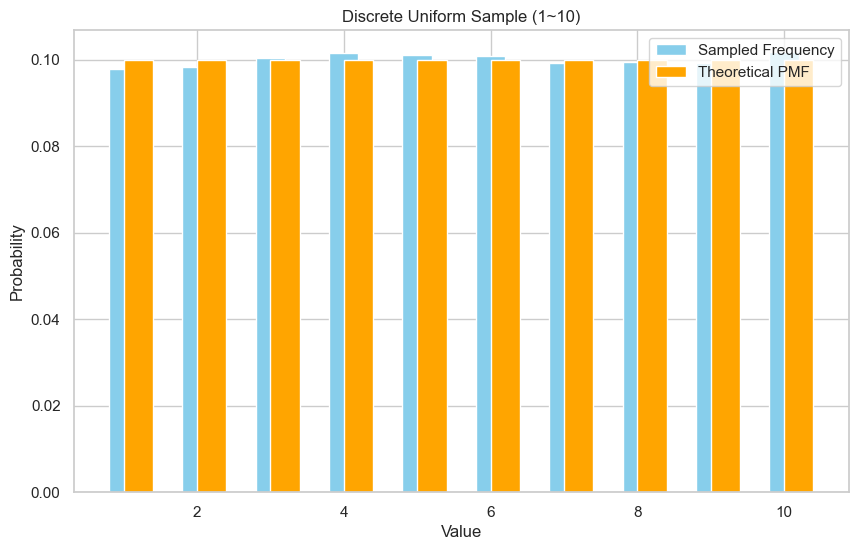
We sample 10,000 times to see if the distribution is uniform. You should see bar heights roughly equal for 1 to 6.
import random
import matplotlib.pyplot as plt
from math import comb

# Sampling
a, b, N = 1, 10, 30000
origin_samples, samples = discrete_uniform_sample(a, b, N)
print(f"Empirical mean: {sum(samples)/len(samples):.3f}")
# Frequency Stats
counts = [samples.count(k) / N for k in range(a, b+1)]

# Calculate Theoretical PMF
theoretical = [1/(b-a+1) for _ in range(a, b+1)]
print(f"PMF = {theoretical}")

# Step 5: Visualization
plt.figure(figsize=(10, 6))
plt.bar(range(a, b+1), counts, width=0.4, label='Sampled Frequency', color='skyblue', align='center')
plt.bar(range(a, b+1), theoretical, width=0.4, label='Theoretical PMF', color='orange', align='edge')
plt.xlabel("Value")
plt.ylabel("Probability")
plt.title(f"Discrete Uniform Sample ({a}~{b})")
plt.legend()
plt.grid(True)
plt.show()
Empirical mean: 5.515
PMF = [0.1, 0.1, 0.1, 0.1, 0.1, 0.1, 0.1, 0.1, 0.1, 0.1]
Continuous Uniform Random Variable
What is a Continuous Uniform Distribution?
A random variable $X \sim \text{Uniform}(a, b)$, if every value in the interval $[a, b]$ is equally likely to occur, is said to follow a continuous uniform distribution.
Mathematical Definition
- Support: $X \in [a, b]$
- Probability Density Function (PDF): $$ f_X(x) = \begin{cases} \frac{1}{b - a} & \text{if } x \in [a, b] \\ 0 & \text{otherwise} \end{cases} $$
- Cumulative Distribution Function (CDF): $$ F_X(x) = \begin{cases} 0 & \text{if } x < a \\ \frac{x - a}{b - a} & \text{if } a \leq x \leq b \\ 1 & \text{if } x > b \end{cases} $$
- Expectation ($\mu$): $\frac{a+b}{2}$
- Variance ($\sigma^2$): $\frac{(b-a)^2}{12}$
Reference:
Sampling
Sampling Principle (Inverse Transform Sampling)
The simplest method is:
If $U \sim \text{Uniform}(0,1)$, then
$$ > X = a + (b - a) \cdot U \sim \text{Uniform}(a, b) > $$
💡Why?
- $U \in [0, 1]$ is standard uniform.
- Scaling length by $(b - a)$ and adding $a$ is a “linear map”.
- Transformed $X$ is uniformly distributed on $[a, b]$.
Steps:
Step 1: Generate U ~ Uniform(0, 1)
Step 2: Linear Transform X = a + (b - a) * U
Step 3: X is your sample from Uniform(a, b)
Summary Table
| Item | Content |
|---|---|
| Name | Continuous Uniform(a, b) |
| $f(x) = \frac{1}{b - a}$ | |
| Method | $X = a + (b - a) \cdot U$, where $U \sim \text{Uniform}(0,1)$ |
| Python | random.random() or random.uniform(a, b) |
| Use Case | Monte Carlo, Simulation, Initialization |
import random

def sample_uniform(a, b):
    U = random.random()        # U ~ Uniform(0,1)
    X = a + (b - a) * U        # X ~ Uniform(a, b)
    return X


def sample_uniform_list(a, b, n):
    return [sample_uniform(a, b) for _ in range(n)]

sample_uniform_list(0, 1, 10)
[0.640..., 0.059..., ...]
Directly using uniform(a, b)
This is the standard library wrapper, basically implementing a + (b - a) * random.random().
random.uniform(0, 1)
Verify Sampling Effect
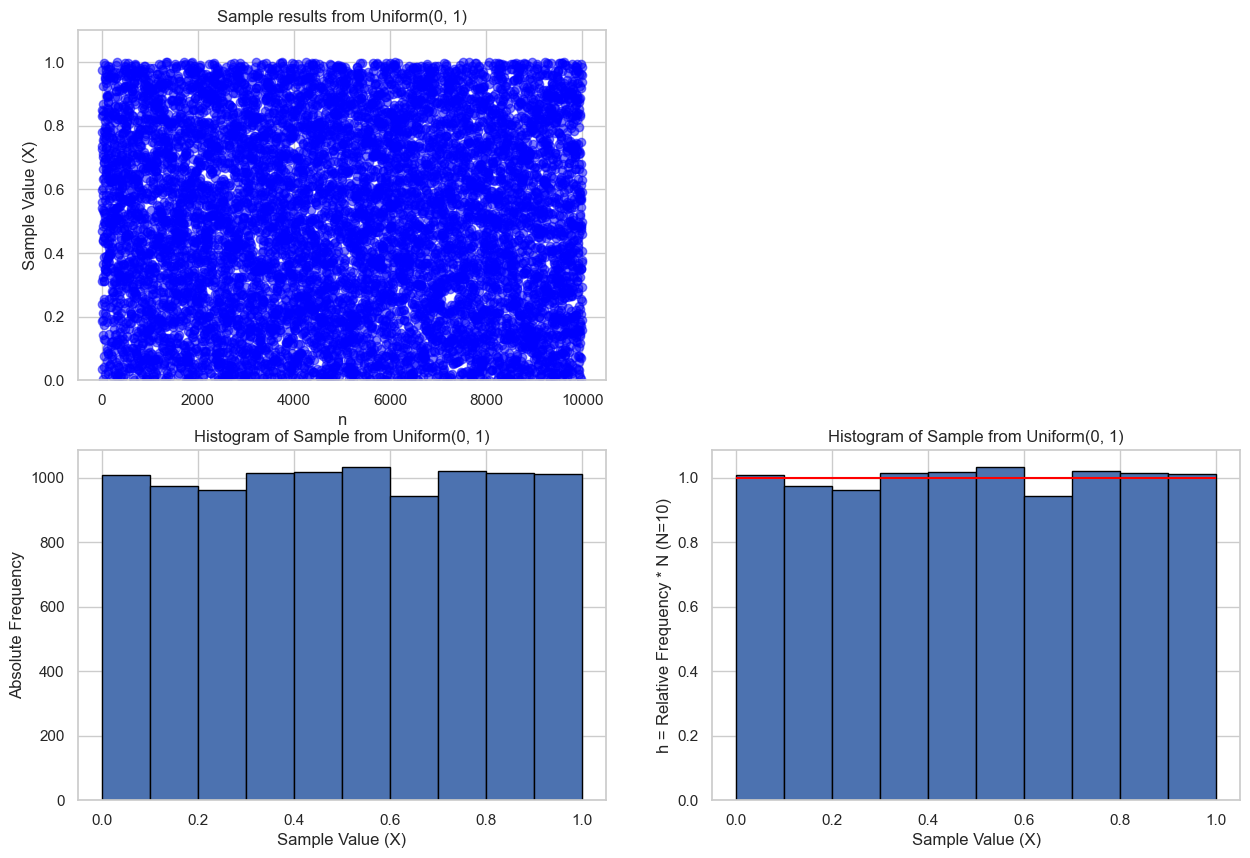
Principle: Check if histogram matches the model. Sample 10,000 points from $X \sim \text{Uniform}(2, 5)$, plot histogram. ✅ If flat, it works.
import matplotlib.pyplot as plt

a, b, n = 0, 1, 10000
pdf = 1 / (b - a)  # PDF of uniform
samples = sample_uniform_list(a, b, n)

plt.figure(figsize=(15, 10))
# Sample results
plt.subplot(2, 2, 1)
plt.scatter(range(n), samples, alpha=0.5, color='blue')
plt.title(f"Sample results from Uniform({a}, {b})")
plt.xlabel("n")
plt.ylabel("Sample Value (X)")
plt.ylim(0, 1.1)

# Histogram (Frequency)
N = 10
plt.subplot(2, 2, 3)
plt.hist(samples, bins=N, density=False, edgecolor='black')
plt.title(f"Histogram of Sample from Uniform({a}, {b})")
plt.xlabel("Sample Value (X)")
plt.ylabel("Absolute Frequency")

# Histogram (Relative Frequency)
plt.subplot(2, 2, 4)
plt.hist(samples, bins=N, density=True, edgecolor='black')
plt.hlines(pdf, a, b, colors='red', linestyles='solid', label='PDF')
plt.title(f"Histogram of Sample from Uniform({a}, {b})")
plt.xlabel("Sample Value (X)")
plt.ylabel(f"h = Relative Frequency * N (N={N})")

plt.show()
Bernoulli Random Variable
Also known as 0-1 distribution. Discrete RV.
Mathematical Definition
Let $X \sim \text{Bernoulli}(p)$, where $0 \le p \le 1$.
- Support: $k \in \{0, 1\}$
- Probability: $$ P(X = 1) = p \\ P(X = 0) = 1 - p $$
- PMF: $$ f(X=k) = \left\{ \begin{aligned} p, \text{if } k=1\\ 1-p, \text{if } k=0 \end{aligned} \right. $$
- CDF: $$ F(X=k) = \left\{ \begin{aligned} 0, \text{if } k \lt 0 \\ 1-p, \text{if } 0 \le k \lt 1\\ 1, \text{ for } k \ge 1 \end{aligned} \right. $$
- Expectation ($\mu$): $p$
- Variance ($\sigma^2$): $p(1-p)$
Reference: Bernoulli distribution
import numpy as np

# Set random seed
np.random.seed(42)

# 1. Define parameters
p = 0.7
values = np.array([0, 1])
n = len(values)
pmf = np.array([1-p, p])
cdf = np.cumsum(pmf)

# 2. Sampling
n_samples = 1000
samples = np.array([np.random.binomial(n=1, p=p) for _ in range(n_samples)])

# 3. Visualization
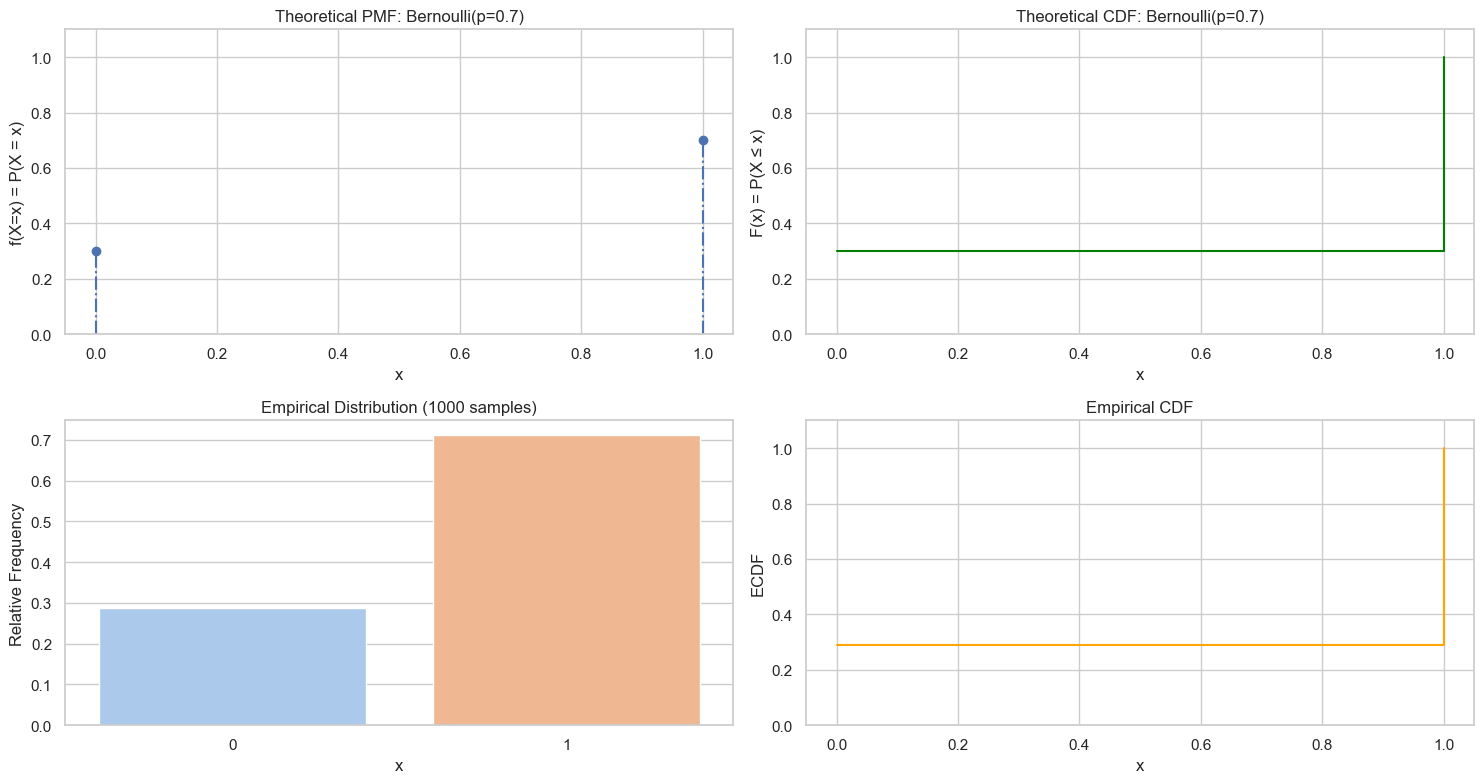
plot_discrete_rv(values, pmf, cdf, samples, f"Bernoulli(p={p})")
Bernoulli Theorem
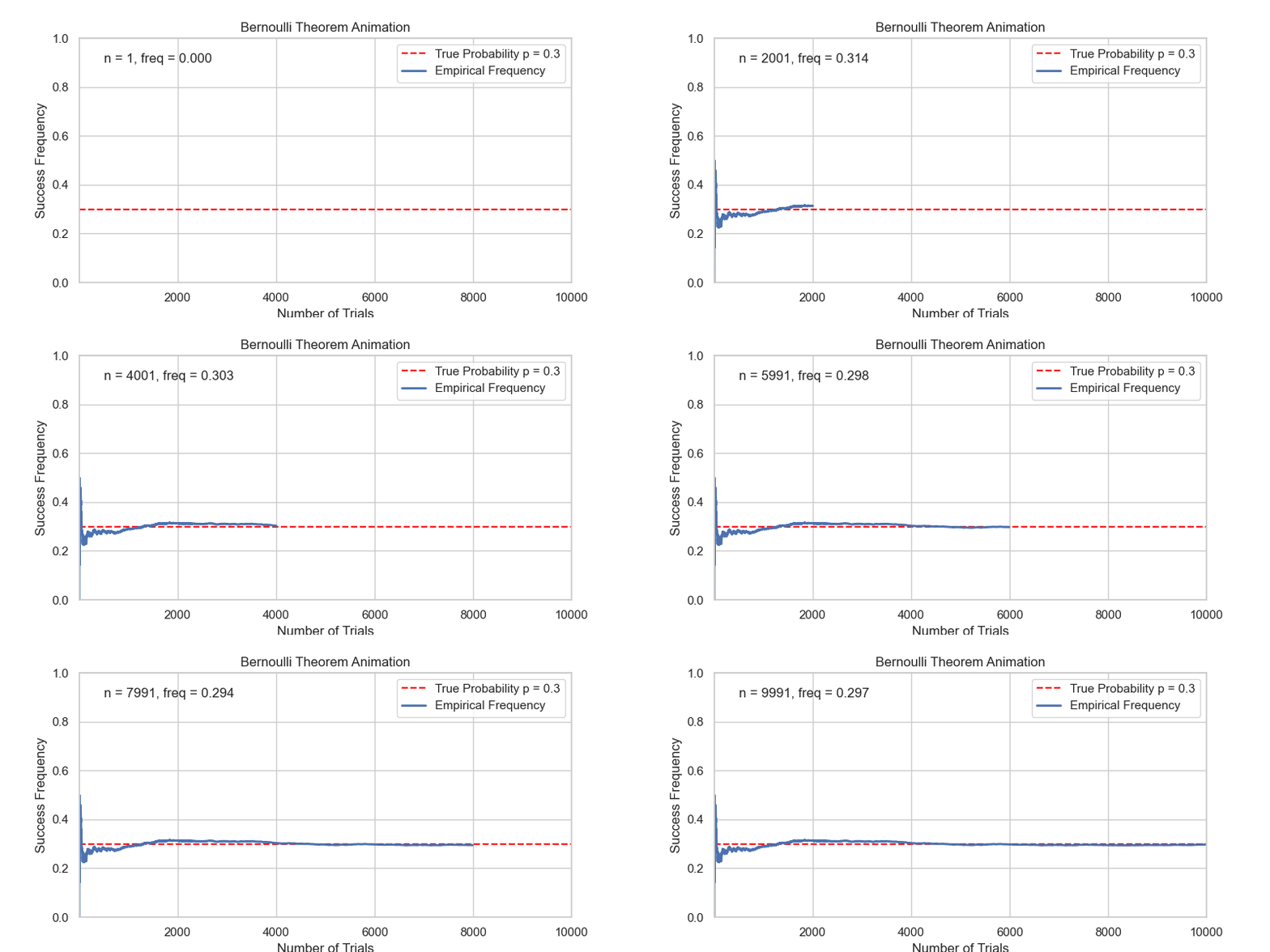
Describes relationship between probability and frequency. As trials increase, relative frequency converges to probability $p$.
$$ \bar{X}_n = \frac{1}{n} \sum_{i=1}^n X_i $$$$ \lim_{n \to \infty} \mathbb{P}\left( \left| \bar{X}_n - p \right| > \epsilon \right) = 0 $$import numpy as np
import matplotlib.pyplot as plt
from matplotlib.animation import FuncAnimation
from IPython.display import HTML
# -----------------------------
# Parameter Setting
# -----------------------------
p = 0.3 # Probability of success
n_trials = 10000 # Total trials
interval = 50 # Animation interval (ms)
# -----------------------------
# Generate Bernoulli Data
# -----------------------------
np.random.seed(0)
samples = np.random.binomial(n=1, p=p, size=n_trials)
cumulative_freq = np.cumsum(samples) / np.arange(1, n_trials + 1)
# -----------------------------
# Create Plot
# -----------------------------
fig, ax = plt.subplots(figsize=(8, 4))
ax.set_ylim(0, 1)
ax.set_xlim(1, n_trials)
ax.axhline(y=p, color='red', linestyle='--', label=f'True Probability p = {p}')
line, = ax.plot([], [], lw=2, label='Empirical Frequency')
text = ax.text(0.05, 0.9, '', transform=ax.transAxes)
ax.set_xlabel('Number of Trials')
ax.set_ylabel('Success Frequency')
ax.set_title('Bernoulli Theorem Animation')
ax.legend()
# -----------------------------
# Update Function
# -----------------------------
def update(frame):
x = np.arange(1, frame + 1)
y = cumulative_freq[:frame]
line.set_data(x, y)
text.set_text(f'n = {frame}, freq = {y[-1]:.3f}')
return line, text
# -----------------------------
# Create Animation
# -----------------------------
ani = FuncAnimation(fig, update, frames=np.arange(1, n_trials + 1, 10),
interval=interval, blit=True)
# Save as GIF
from matplotlib.animation import PillowWriter
ani.save("bernoulli_theorem_animation.gif", writer=PillowWriter(fps=10))
plt.close(fig)
from IPython.display import Image
Image(filename="bernoulli_theorem_animation.gif")
Sampling
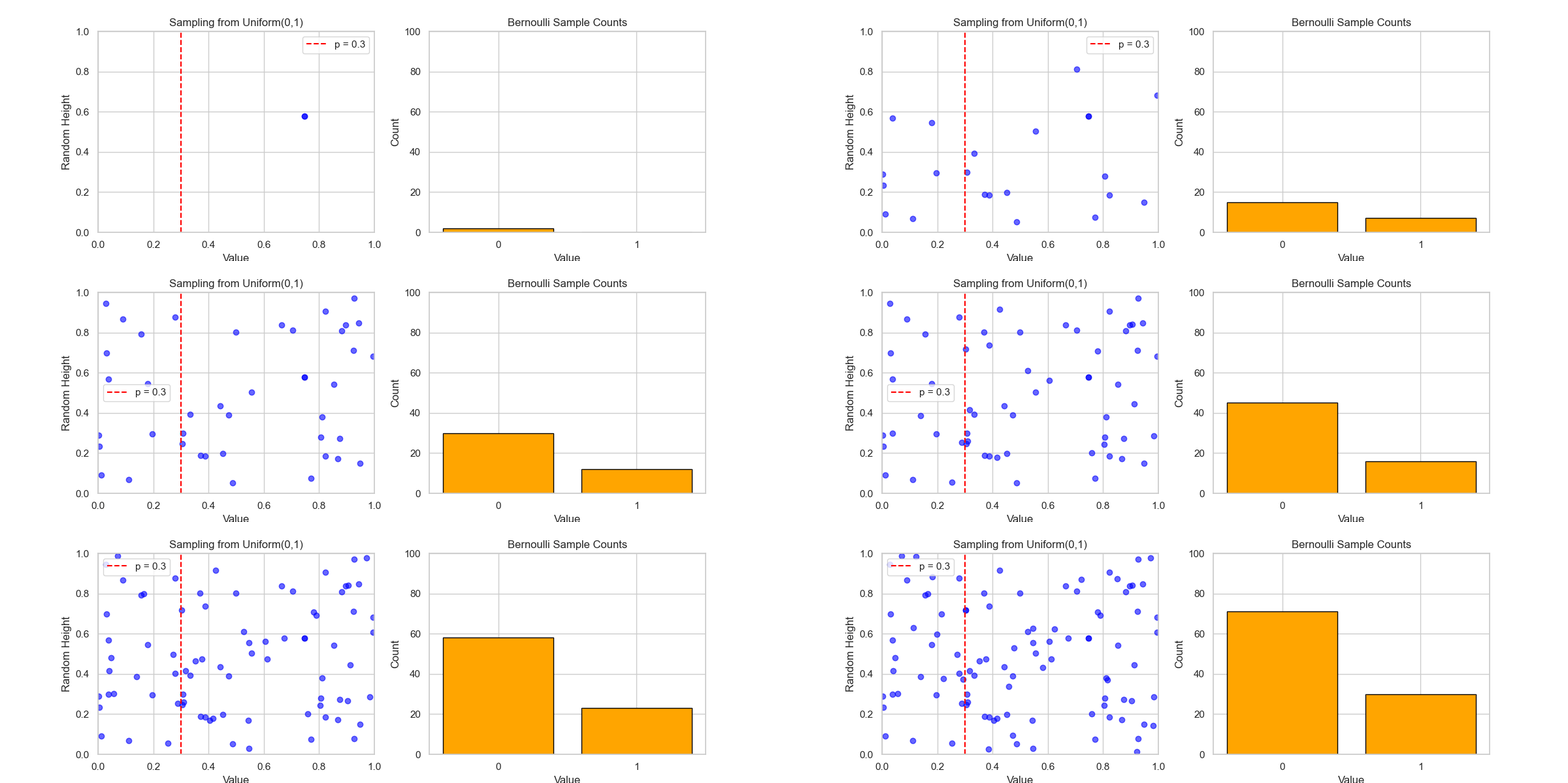
Based on Uniform(0, 1)
🌱 Principle Using $U \sim \text{Uniform}(0,1)$:
- If $U < p$, output 1 (Success)
- Else output 0 (Failure)
import matplotlib.pyplot as plt
import matplotlib.animation as animation
import numpy as np
from IPython.display import HTML

# Parameters
p = 0.3
n_frames = 100

# Pre-generate uniform samples
uniform_samples = np.random.uniform(0, 1, n_frames)
bernoulli_samples = (uniform_samples < p).astype(int)

# Set up the figure and axes
fig, axs = plt.subplots(1, 2, figsize=(12, 4))
uniform_ax = axs[0]
bernoulli_ax = axs[1]

# Initialize plots
uniform_scatter = uniform_ax.scatter([], [], c='blue', alpha=0.6)
bernoulli_bar = bernoulli_ax.bar([0, 1], [0, 0], color='orange', edgecolor='black')

# Configure uniform axis
uniform_ax.axvline(p, color='red', linestyle='--', label=f'p = {p}')
uniform_ax.set_xlim(0, 1)
uniform_ax.set_ylim(0, 1)
uniform_ax.set_title('Sampling from Uniform(0,1)')
uniform_ax.set_xlabel('Value')
uniform_ax.set_ylabel('Random Height')
uniform_ax.legend()
uniform_ax.grid(True)

# Configure Bernoulli axis
bernoulli_ax.set_xlim(-0.5, 1.5)
bernoulli_ax.set_ylim(0, n_frames)
bernoulli_ax.set_title('Bernoulli Sample Counts')
bernoulli_ax.set_xlabel('Value')
bernoulli_ax.set_ylabel('Count')
bernoulli_ax.set_xticks([0, 1])
bernoulli_ax.grid(True)

# Store sample counts
count_0 = 0
count_1 = 0
x_vals = []
y_vals = []

# Animation update function
def update(frame):
    global count_0, count_1, x_vals, y_vals

    u = uniform_samples[frame]
    x_vals.append(u)
    y_vals.append(np.random.rand())  # random y position for scatter

    bern_sample = bernoulli_samples[frame]
    if bern_sample == 0:
        count_0 += 1
    else:
        count_1 += 1

    # Update scatter
    uniform_scatter.set_offsets(np.column_stack((x_vals, y_vals)))

    # Update bar chart
    bernoulli_bar[0].set_height(count_0)
    bernoulli_bar[1].set_height(count_1)

    return uniform_scatter, bernoulli_bar

# Create animation
ani = animation.FuncAnimation(fig, update, frames=n_frames, interval=100, blit=False)
# Save as GIF
from matplotlib.animation import PillowWriter
ani.save("sample_uniform_to_bernoulli.gif", writer=PillowWriter(fps=10))

plt.close(fig)

from IPython.display import Image
Image(filename="sample_uniform_to_bernoulli.gif")
import random
def sample_bernoulli(p):
    U = random.random()
    return 1 if U < p else 0

p, N = 0.7, 10000
samples = [sample_bernoulli(p) for _ in range(N)]
print(f"Empirical mean: {sum(samples)/len(samples):.3f}")  # Should be close to 0.7
Binomial Random Variable
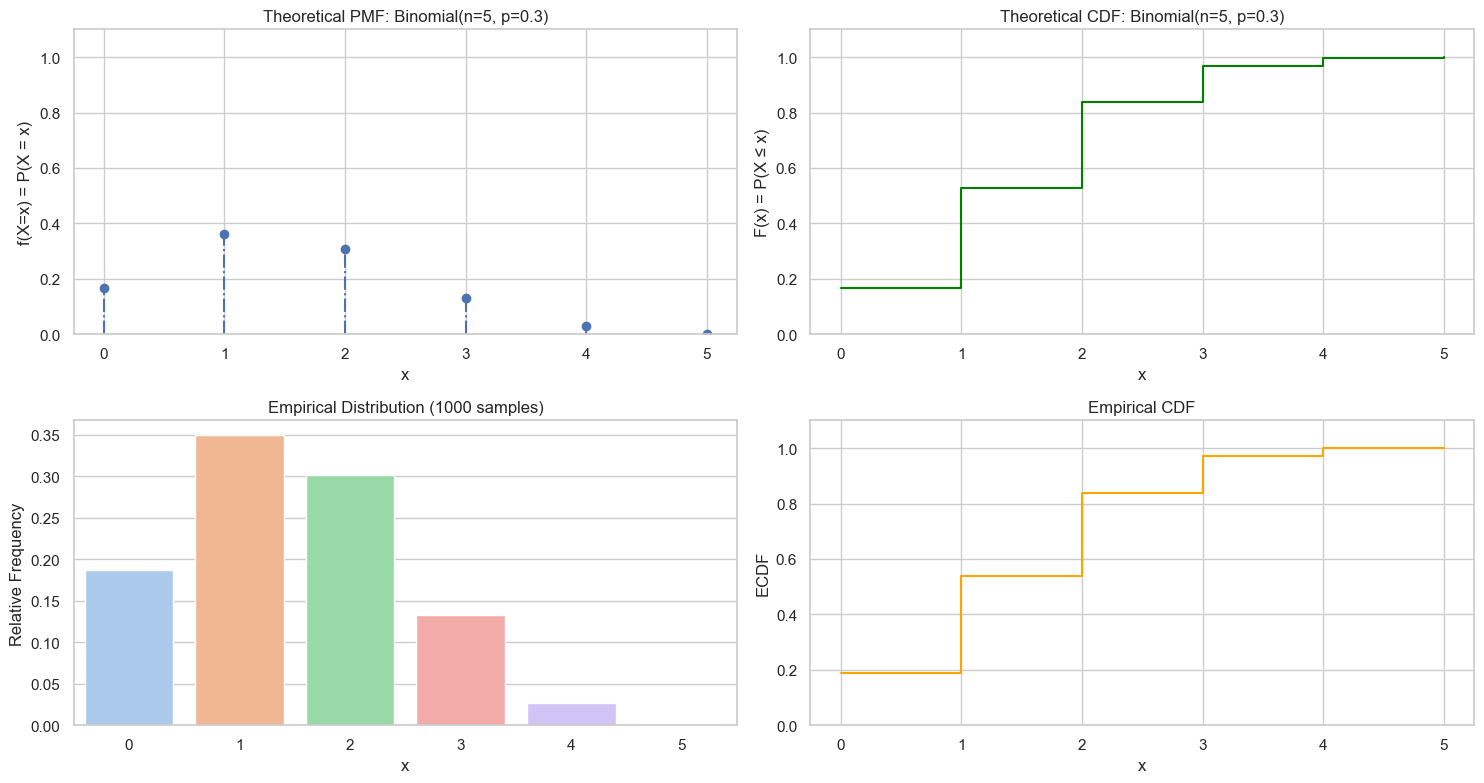
$X \sim \text{Binomial}(n, p)$ represents the total number of successes in $n$ independent Bernoulli trials (probability $p$).
Mathematical Definition
- Support: $k \in \{0, \dots, n\}$
- Probability: $$ P(X = k) = \begin{pmatrix} n \\ k \end{pmatrix}p^k(1-p)^{(n-k)} $$
- Expectation: $np$
- Variance: $np(1-p)$
Reference: Binomial distribution
from scipy.stats import binom
import numpy as np

# Random Seed
np.random.seed(42)

# 1. Define Parameters
n, p = 5, 0.3
values = range(n + 1)
pmf = binom.pmf(values, n, p)
cdf = np.cumsum(pmf)

# 2. Sampling
n_samples = 1000
samples = np.random.binomial(n=n, p=p, size=n_samples)

# 3. Visualization
plot_discrete_rv(values, pmf, cdf, samples, f'Binomial(n={n}, p={p})')
Sampling Methods
| Method | Idea | Scope | Exact? | Easy? |
|---|---|---|---|---|
| 1. Repeated Bernoulli | Sum $n$ Bernoullis | Any $n, p$, especially small $n$ | ✅ | ✅ |
| 2. Inverse Transform | Find first $k$ where $F(k) \ge u$ | Small $n$ | ✅ | ⚠️ |
| 3. Table Lookup | Precompute $F(k)$ | Small $n$, repeated sampling | ✅ | ✅ |
| 4. Rejection Sampling | Accept/Reject with proposal | Medium $n$, simulation | ✅ | ⚠️ |
| 5. Normal Approx | $\mathcal{N}(np, np(1-p))$ | Large $n$, $np(1-p) \ge 10$ | ❌ | ✅ |
| 6. Poisson Approx | $\text{Poisson}(np)$ | Large $n$, small $p$ | ❌ | ✅ |
| 7. BTPE (NumPy) | Fast specialized algo | Any | ✅ | ⚠️ |
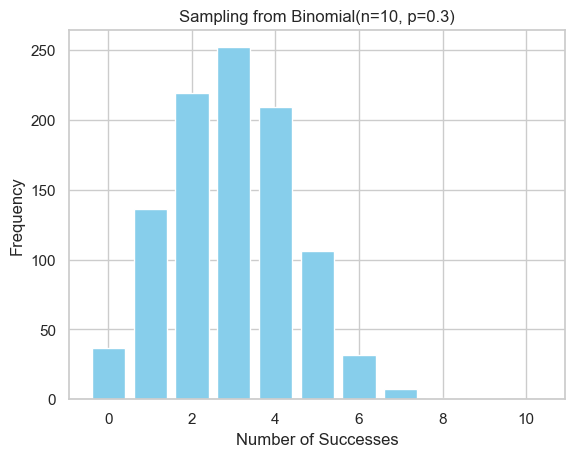
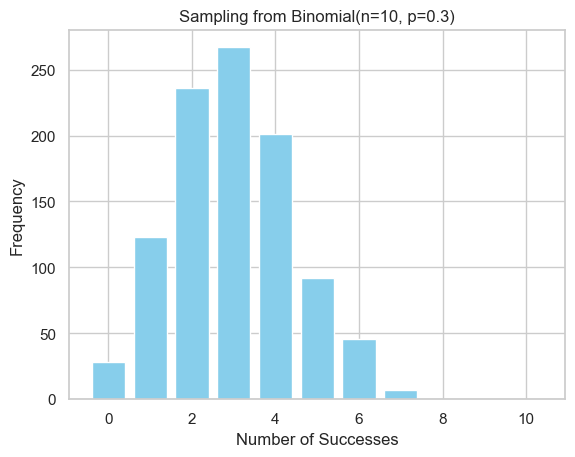
Method 1: Repeated Bernoulli
Simple sum of $n$ coin flips.
import random

def sample_binomial_mimic(n, p):
    count = 0
    for _ in range(n): # repeat N times Bernouli sampling
        u = random.random()
        if 1-p <= u < 1:
            count += 1
    return count

def sample_binomial_mimic_list(n, p, num_samples):
    return [sample_binomial_mimic(n, p) for _ in range(num_samples)]
Method 2: Inverse Transform
Find $k$ such that $F(k-1) < U \le F(k)$.
import random
from math import comb

def sample_binomial_inverse(n, p):
    u = random.random()
    cumulative = 0.0
    for k in range(n + 1):
        prob = comb(n, k) * (p ** k) * ((1 - p) ** (n - k))
        cumulative += prob
        if u <= cumulative:
            return k
    return n

def sample_binomial_inverse_list(n, p, num_samples):
    return [sample_binomial_inverse(n, p) for _ in range(num_samples)]
Method 3: Table Lookup
Precompute CDF table for faster repeated sampling.
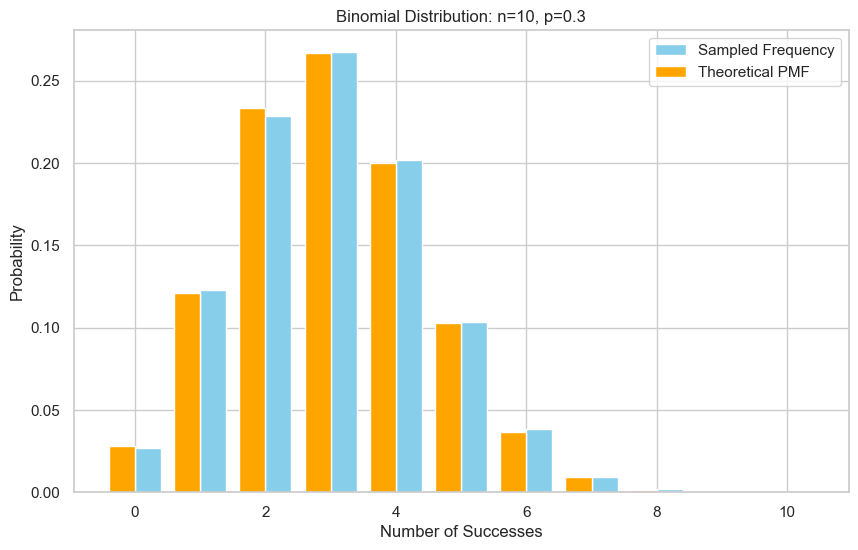
Method 4: Rejection Sampling
Use a proposal $g(k)$ (e.g. Uniform) and scaling $M$.
Method 5: Normal Approximation
Use $X \approx \mathcal{N}(np, np(1-p))$. Round result to integer. Condition: $np \ge 10$ and $n(1-p) \ge 10$. Continuity correction: $X \approx \text{round}(Y + 0.5)$.
Exponential Random Variable
Continuous RV. Models time between events.
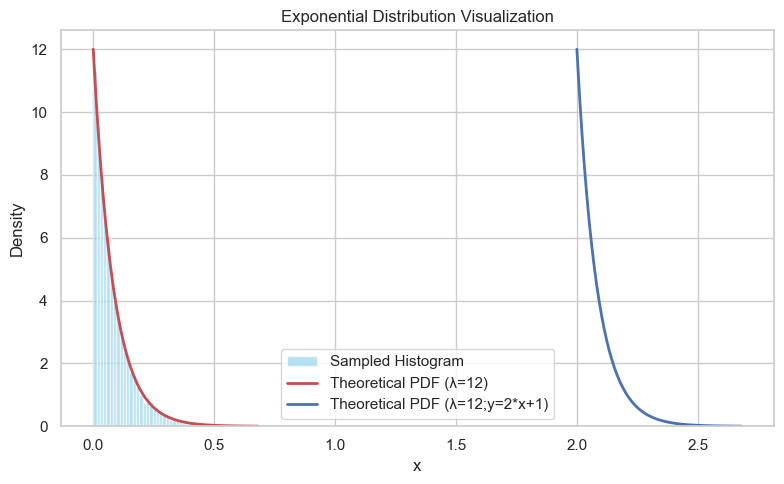
Mathematical Definition $X \sim \text{Exp}(\lambda)$.
- PDF: $f(x) = \lambda e^{-\lambda x}, x \ge 0$.
- CDF: $F(x) = 1 - e^{-\lambda x}, x \ge 0$.
- Mean: $1/\lambda$. Variance: $1/\lambda^2$.
Sampling (Inverse Transform)
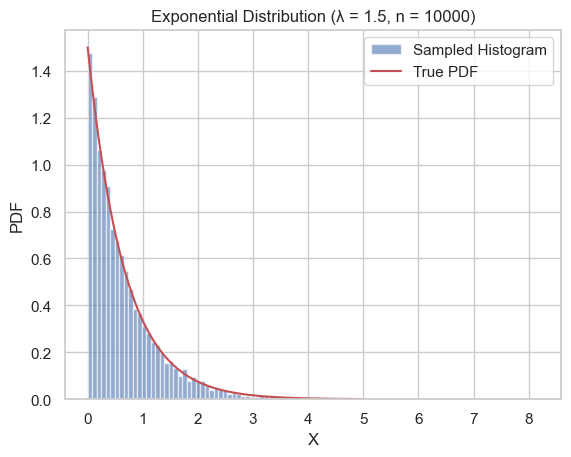
Formula:
$$ X = -\frac{\ln(1-U)}{\lambda} $$Since $1-U \sim U$, simplified to $X = -\ln(U)/\lambda$.
import random
import math

def sample_exponential_inverse(lambda_val):
    u = random.random()
    return -math.log(1-u) / lambda_val
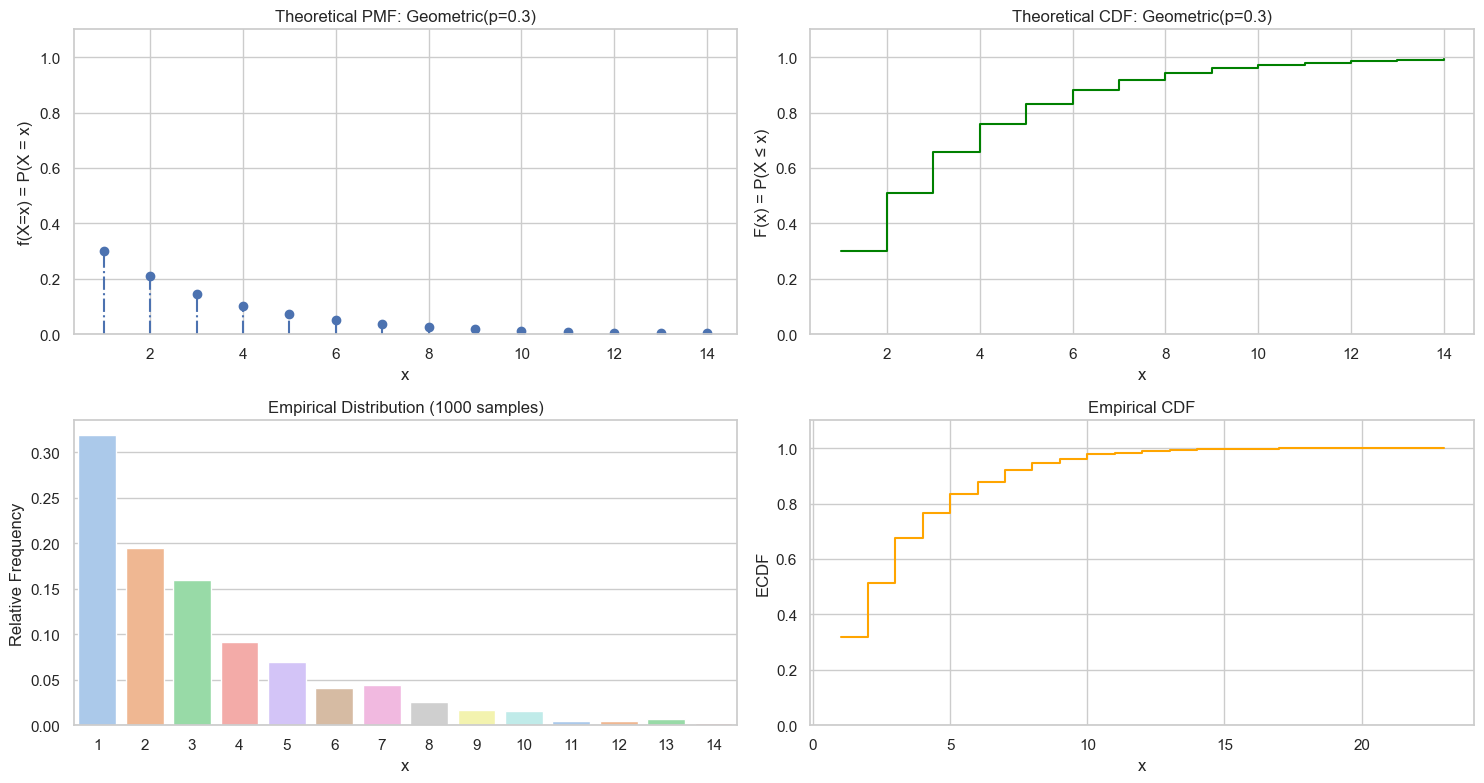
Geometric Random Variable
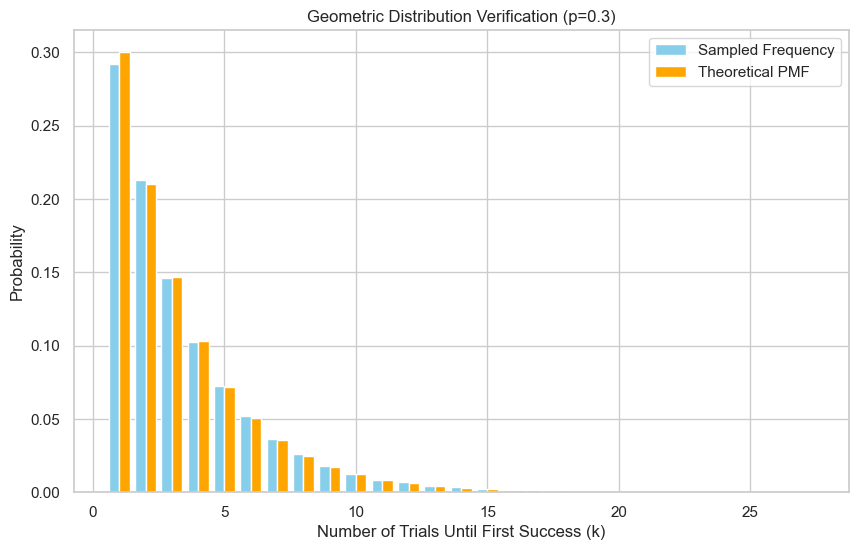
Discrete RV. Number of trials until first success.
Mathematical Definition $X \sim \text{Geometric}(p)$. Support $\{1, 2, \dots\}$.
- PMF: $P(X=k) = (1-p)^{k-1}p$.
- CDF: $P(X \le k) = 1 - (1-p)^k$.
- Mean: $1/p$. Variance: $(1-p)/p^2$.
Sampling
Inverse Transform (Closed Form)
$$ k = \left\lceil \frac{\ln(1-U)}{\ln(1-p)} \right\rceil $$Efficient ($O(1)$).
def sample_geometric_inverse(p):
    u = np.random.uniform(0, 1)
    return int(np.ceil(np.log(1 - u) / np.log(1 - p)))
Normal Random Variable
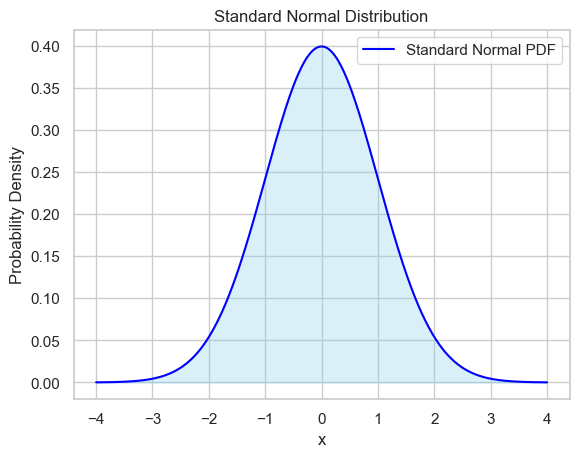
Gaussian distribution. $f(x) = \frac{1}{\sqrt{2\pi\sigma^2}}e^{-\frac{(x-\mu)^2}{2\sigma^2}}$. Standard Normal: $\mu=0, \sigma=1$.
Sampling Standard Normal
| Method | Principle | Note |
|---|---|---|
| Box-Muller | Polar transform | Exact, 2 samples at once |
| CLT | Sum of Uniforms | Approximate |
| Rejection | Envelope | General but maybe inefficient |
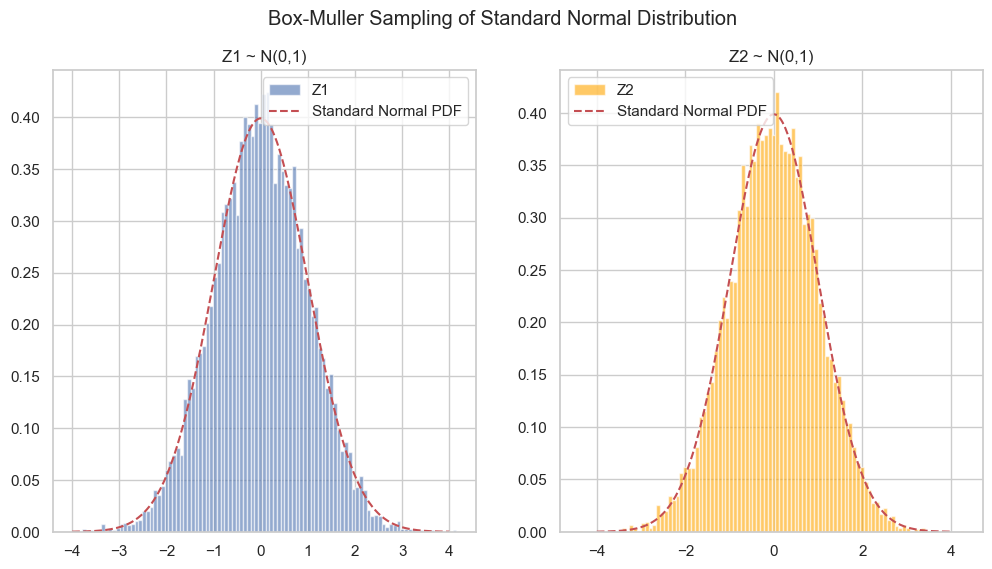
Method 1: Box-Muller
Use two $U_1, U_2$:
$$ Z_1 = \sqrt{-2\ln U_1}\cos(2\pi U_2) \\ Z_2 = \sqrt{-2\ln U_1}\sin(2\pi U_2) $$Both are independent $\mathcal{N}(0,1)$.
Method 2: CLT
Sum of 12 Uniforms: $Z = \sum_{i=1}^{12} (U_i - 0.5)$. Variance is 1.
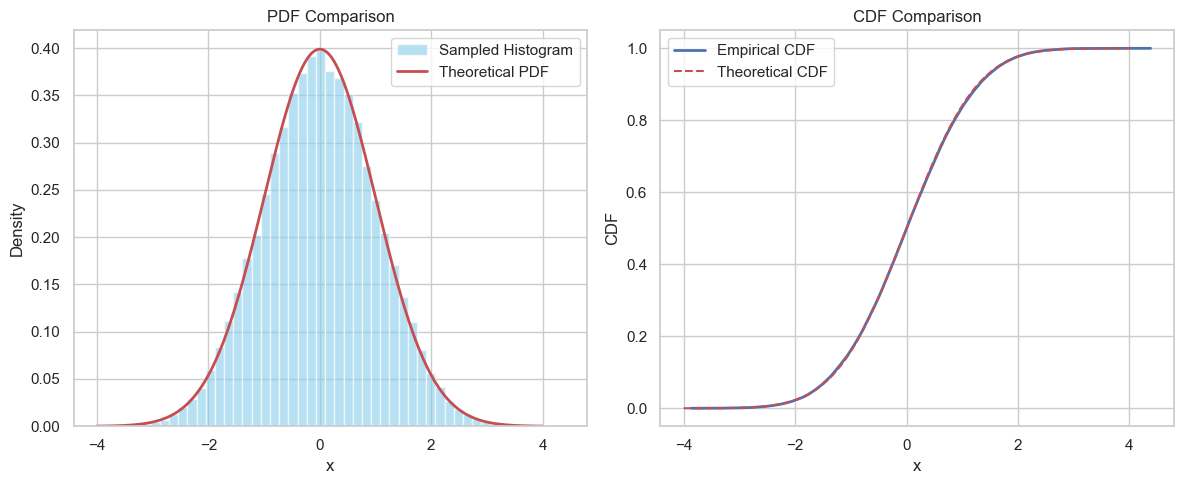
Sampling from Joint Distributions
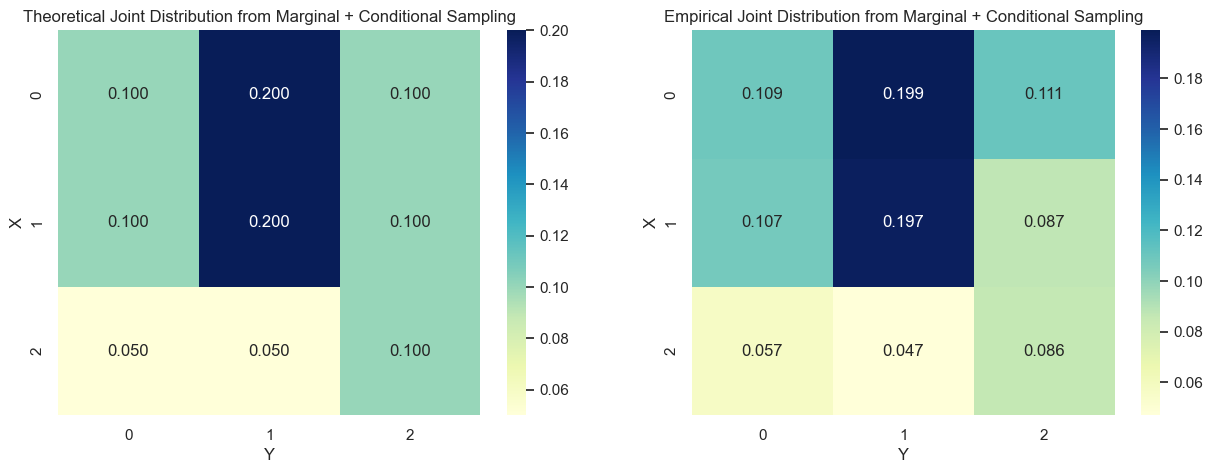
2D Discrete
- Flattening: Treat $(x,y)$ pairs as 1D list, use Inverse Transform.
- Marginal + Conditional: Calculate $P(X)$, sample $x$. Calculate $P(Y|x)$, sample $y$.
Continuous
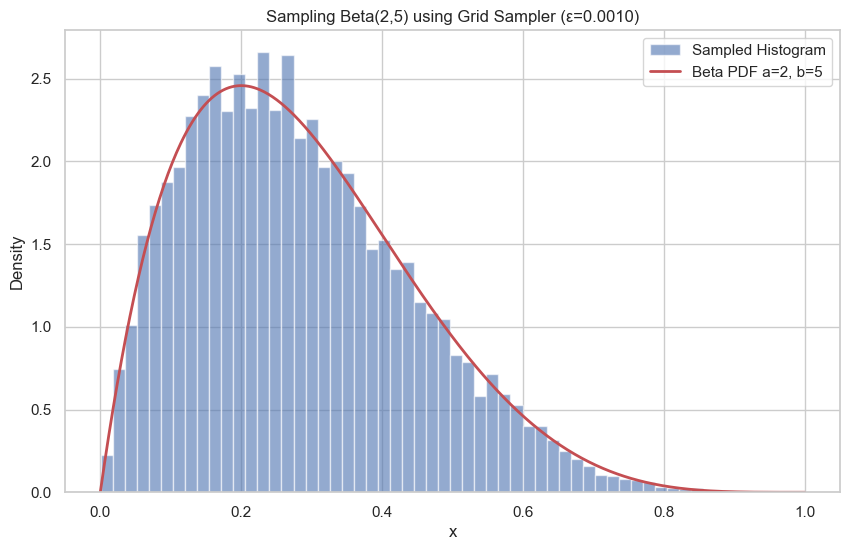
Grid Sampler
Recursively divide interval (binary tree), sample based on interval mass. Used for high-precision or when Inverse CDF is unknown but CDF is calculable.
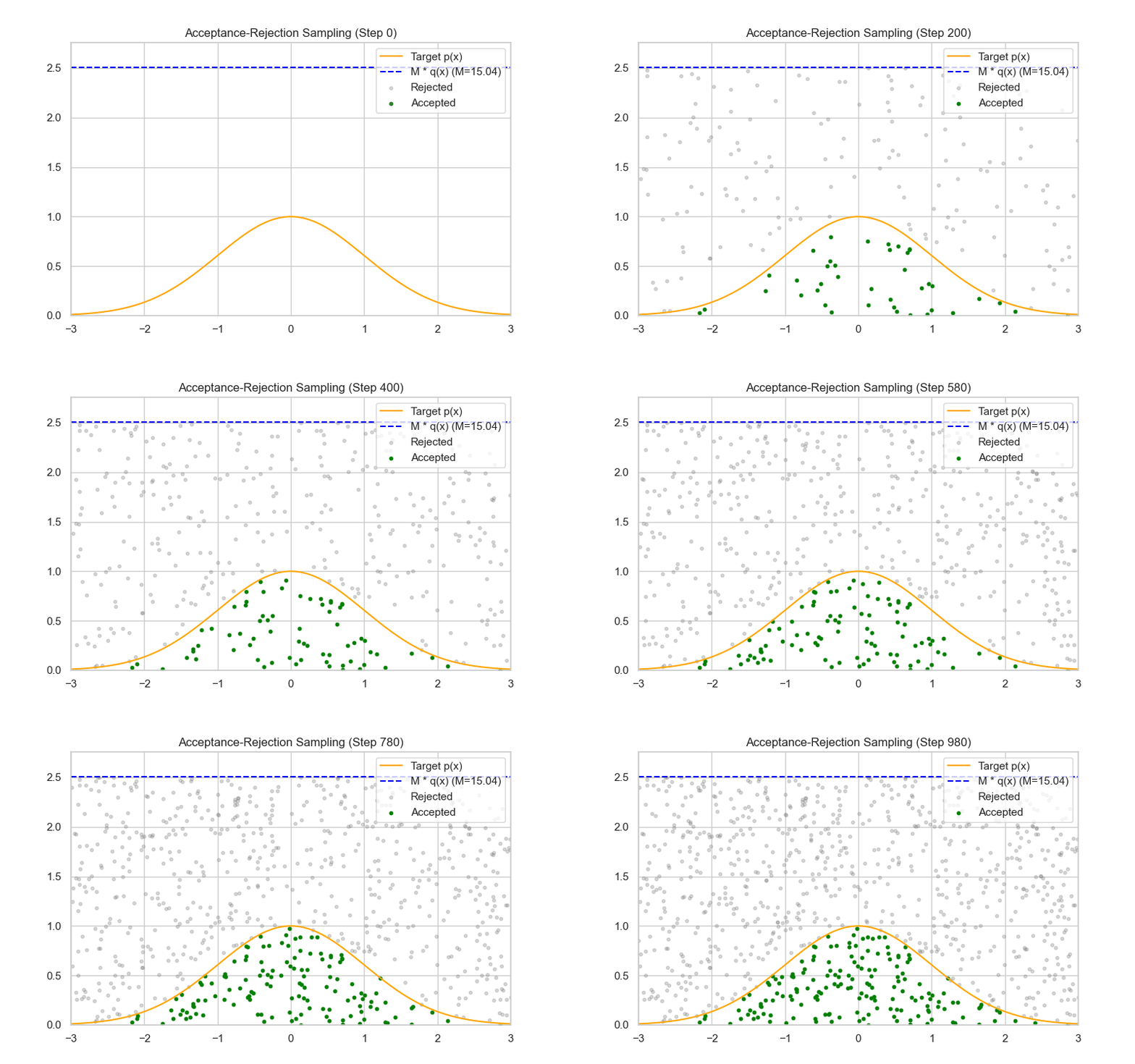
Rejection Sampling (General)
Accept if $u \le \frac{f(x)}{M q(x)}$.
Computations with Random Variables
Transformation
Linear: $Y=aX+b \Rightarrow f_Y(y) = f_X(\frac{y-b}{a})|\frac{1}{a}|$. Nonlinear: $Y=g(X) \Rightarrow f_Y(y) = f_X(g^{-1}(y)) |\frac{d}{dy}g^{-1}(y)|$.
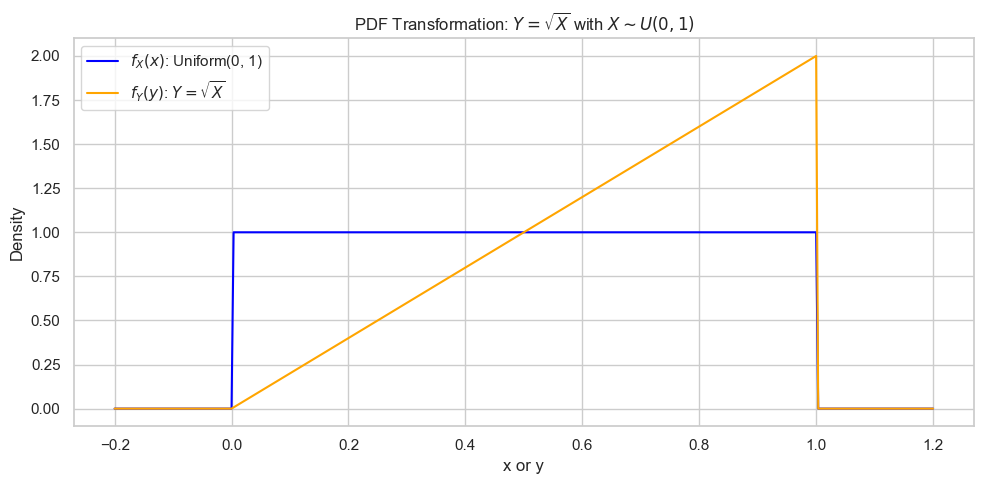
Example: $Y=\sqrt{X}, X \sim U(0,1) \Rightarrow f_Y(y) = 2y$ on $[0,1]$.
Mean Operator ($\mathbb{E}$)
Linear operator. $\mathbb{E}[g(X)] = \int g(x)f(x)dx$.
Propagation of Error
Approximate variance of $Y=g(X)$ via Taylor expansion:
$$ \text{Var}(Y) \approx [g'(\mu_X)]^2 \text{Var}(X) $$Multivariate:
$$ \text{Var}(Y) \approx \nabla g^T \Sigma \nabla g $$Appendix: Sampling from Polar Coordinates
Transform known $(X,Y)$ to $(R^2, \alpha)$ via Jacobian $|J|=1/2$.
$$f_{R^2, \alpha}(u, v) = 2 f_{X,Y}(\sqrt{u} \cos v, \sqrt{u} \sin v)$$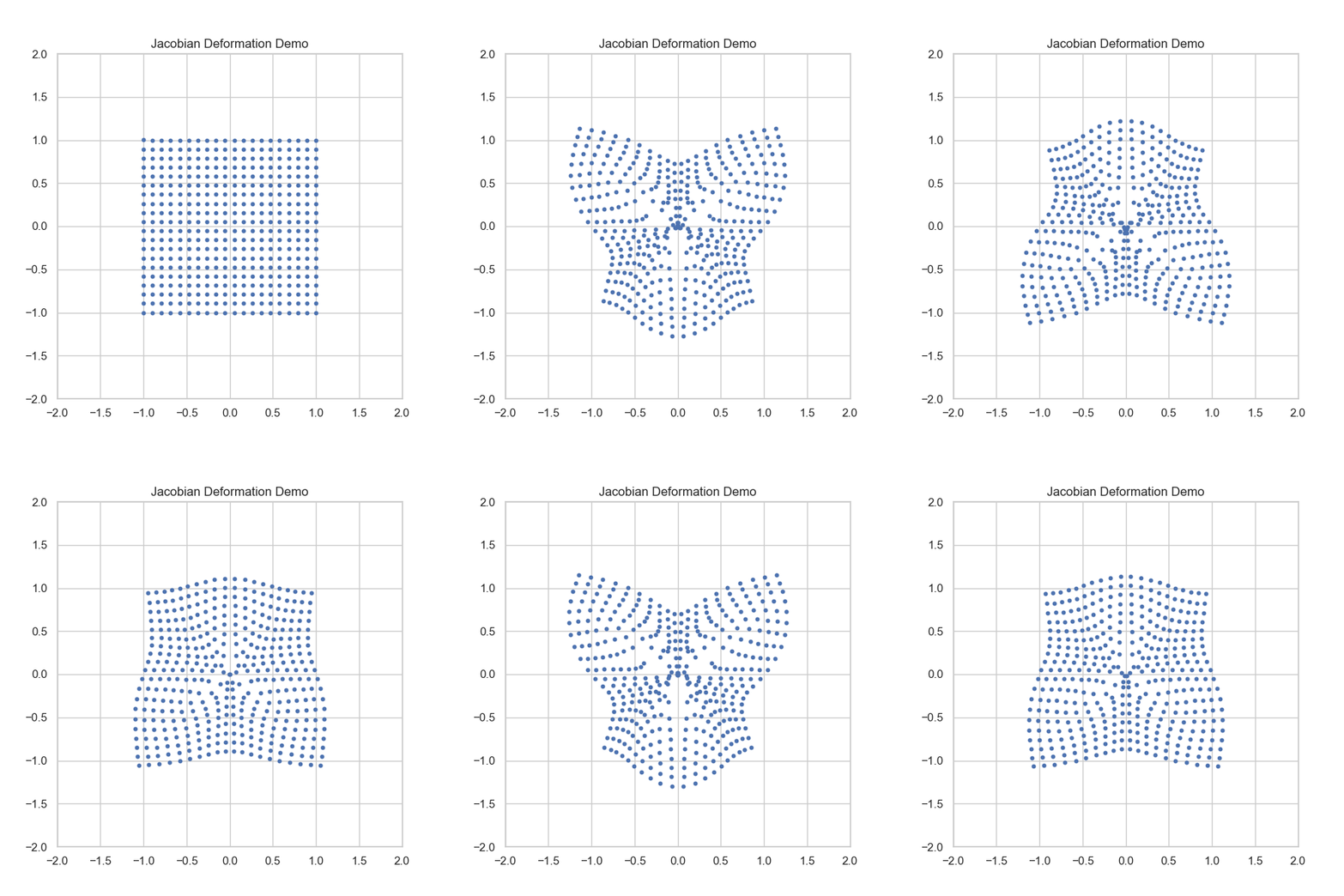
Scan to Share
微信扫一扫分享